
What Are the Best Ways to Improve Sleep Quality?
Posted on
By Samuel shonubi

Last Updated: October 28, 2026
Quick Summary
The best ways to improve sleep quality combine a consistent sleep schedule, morning light exposure, and a sequenced wind-down that moves caffeine, alcohol, food, work and screens further from bedtime. Track sleep onset, nighttime waking and morning feel to see what works, and speak with a GP if problems persist.
The best ways to improve sleep quality rarely involve a single dramatic change. They come from small, repeatable habits that stack up over weeks. The people who fix their routine first may get more from every product they buy afterwards.
Sleep quality is the measure of how well you move through the stages of sleep, not simply how many hours you spend in bed. Two people can log eight hours and wake up in completely different states.
That distinction matters because poor sleep affects mood, concentration, appetite and how well the body repairs itself. Many people find that daytime energy problems trace back to fragmented nights rather than short ones. Below, we'll explore habits that may support sleep and ways to build a plan you can stick to.
Most adults need between seven and nine hours of sleep per night, according to guidance from the NHS on sleep and tiredness. Some people genuinely function well on slightly less, but the majority who believe they are in that group are not.
Age changes the picture. Teenagers typically need more, often eight to ten hours (Sleep (older children)). Older adults often sleep more lightly and wake more frequently, which makes routine and environment more important rather than less.
The number on the clock is only half the story. Consistency matters as much as duration: going to bed and waking at similar times each day supports your body clock more effectively than catching up at weekends. A common mistake is sleeping in for three hours on a Sunday and wondering why Monday night feels impossible.
A consistent sleep schedule is one change people can consider making. Pick a wake time you can hold seven days a week, then work backwards to set your bedtime.
Here is one way to approach it:
If mornings are the weak point, a gradual-light wake-up helps more than a jarring alarm. Our sunrise alarm clock brightens over time to mimic dawn, with built-in white noise and app control so you can set the whole routine from your phone.
Shifting your bedtime dramatically in one night can be frustrating.
Sleep hygiene is the set of daily habits and environmental conditions that support good sleep. It is not a checklist to complete once; it is the background system your nights run on.
Some habits may suit one person better than another. The two areas below are worth considering.
Morning light is the strongest signal your body clock receives. Getting outside within an hour of waking, even on a grey day, helps set the timing of your sleep later that night. A Sleep Foundation overview of light exposure and circadian rhythm explains how this timing effect works.
For evening screen use, our blue light blocking glasses filter blue light.

Caffeine has a long tail. A coffee at 4pm can still be measurably active at 10pm.
Food and drink timing matters too.
The 10-5-3-2-1 sleep rule is a simple countdown framework for the hours before bed. Each number marks a cutoff for one habit, so you are not trying to remember ten separate instructions at once.
| Cutoff | Time Before Bed | What to Stop |
|---|---|---|
| 10 hours | 10 hours | Caffeine |
| 5 hours | 5 hours | Alcohol |
| 3 hours | 3 hours | Food and heavy meals |
| 2 hours | 2 hours | Work and stimulating tasks |
| 1 hour | 1 hour | Screens and bright light |
Treat it as a template rather than a law. Someone on a 6am start has a very different evening from someone finishing work at 10pm. The value is in the sequencing: it forces the biggest disruptors furthest from bedtime.
The framework is a countdown of suggested cutoffs:
A stepwise sequence to try:
Week one: Move your last caffeine to before midday and keep everything else unchanged.
Week four: Add the wind-down and screen cutoffs together.
Treating the numbers as fixed. Shift workers and people with irregular schedules should anchor the sequence to their actual bedtime, not to a clock time.
Confusing the rule with treatment. If you have persistent insomnia, the framework is a supporting habit, not a substitute for professional assessment.
The rule is a way to sequence the evening.
A dark, quiet and slightly cool bedroom is one environment to consider.
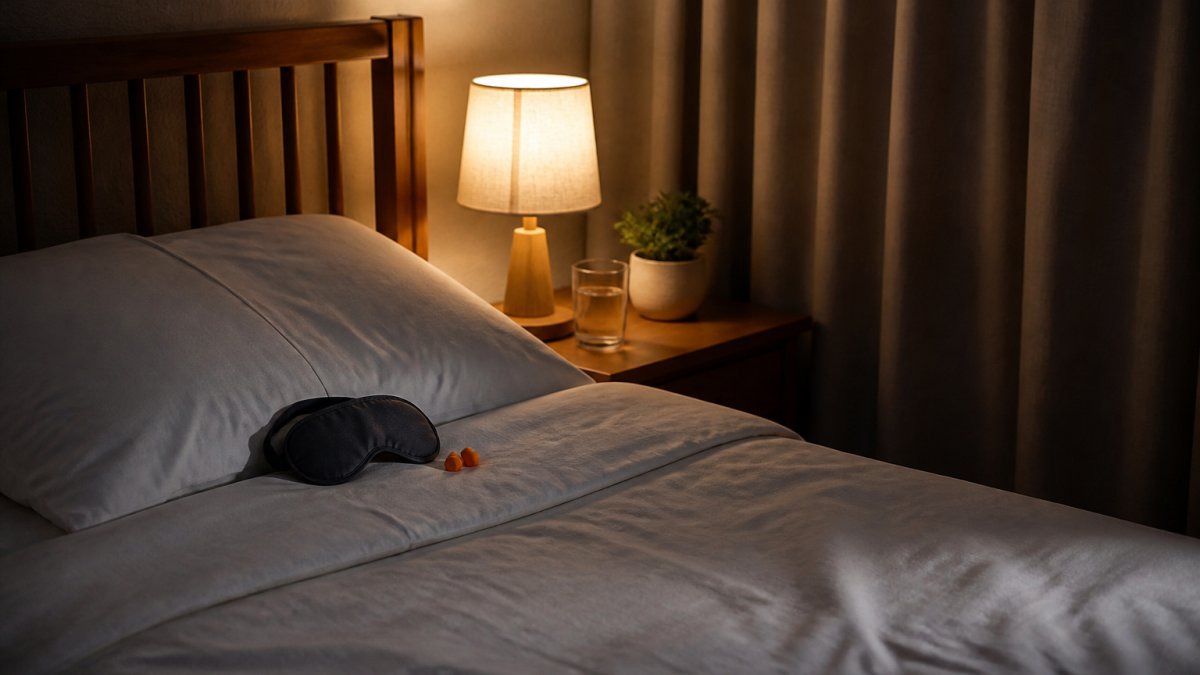
Our 3D blackout sleep mask blocks light completely and carries magnetically attached earplugs.
A sleep sound machine offers white noise, nature sounds or lullabies, with a dimmable night light and an adjustable timer. Silicone earplugs are another option.


You can track sleep in different ways. Total hours in bed is one measure.
Track these instead:
A paper log is one option. Our smart ring health sleep tracker measures sleep duration and quality.
If sleep problems persist despite habit changes, consider speaking with a GP.
Sleep apnoea involves breathing repeatedly pausing during the night.
If sleep problems persist, consider speaking with a GP.
If your schedule is not standard, you may need to adapt your routine to fit your circumstances.
Shift workers face two problems at once: the body clock is being asked to move, and daytime sleep fights both light and noise.
When someone else controls your nights, your routine may need to be flexible.
If you have tried the habits in this guide and sleep has not improved, consider these options:
You could try anchoring your wake time, protecting the hour before bed, and making the room dark and quiet.
The habits in this guide are one part of a wind-down routine. Products can be another part.
We offer a curated collection of wellness products, with free UK delivery available. A weighted blanket has a reversible design with fleece on one side and Sherpa on the other. A cooling contour cervical pillow has two height options and is described as suitable for multiple sleeping positions.
Start with one change this week: consider adjusting your wake time. Explore the curated collection at Infinite Finds.
You could try keeping a consistent bedtime and wake time, including weekends. Other routine ideas include getting morning daylight, limiting screens before bed, and making your bedroom dark, quiet and cool. You can keep a sleep log if you want to note your routine.
The 10-5-3-2-1 sleep rule is a countdown framework for the hours before bed. It assigns cutoffs to caffeine, meals, alcohol, work and screens. Treat it as a framework rather than a clinical guideline.
Whether seven hours feels sufficient can vary from person to person. If you have concerns about your sleep, consider speaking with a GP.
Two hours is a short amount of sleep. If you are concerned about your sleep, consider speaking with a GP.
You could try a wind-down routine, such as dimming the lights, putting screens away and doing something quiet. A blackout sleep mask, silicone earplugs or a white noise machine are also options to consider. The sleep mask is listed as blocking light, and the sound machine offers white noise.
If poor sleep persists or concerns you, consider speaking to your GP. A GP can advise you about your situation.
