To choose the right massager, first name the body area that hurts, then match the device type to that area before comparing features. Percussion guns suit large muscles, kneading massagers suit the neck and shoulders, and air compression suits tired legs and feet.
Name the main body area you want to target before you shop.
Match the device family to the body area first, then compare features within that family.
Start a massage gun on a low speed and build up gradually.
Use a massager for 10 to 15 minutes at a time, once or twice a day.
Stop if you feel sharp pain, numbness or tingling, and avoid bones, joints and bruises.
Start With the Body Area and Muscle You Want to Target
To choose the right massager, start with one question: where does it hurt? Many people buy the wrong device because they skip this step. A neck tension problem and a sore calf need very different tools.
Think about the specific area first. Is it your neck, your shoulders, your lower back, or your feet?
Watch out: buying a powerful gun for a small area can cause bruising if you press too hard for too long.
Quick checklist before you shop:
Name the main body area you want to target
Note whether the pain is in large muscles or small ones
Decide if you need heat, deep pressure, or both
Set a rough budget before you browse
Understanding the Types of Body Massagers
Massagers fall into a handful of families, and each one delivers force to the body in a different way. The fastest way to choose well is to match the family to the job, not to buy the most powerful device on the shelf. The table below sets out a general decision framework for narrowing a shortlist.
Family
How it delivers force
Best for
Watch-outs
Handheld percussion (massage gun)
Fast, short pulses driven into the muscle
Large muscle groups, post-exercise soreness, quick sessions
Can bruise small areas if pressed hard; noise and battery matter
Kneading / shiatsu
Rotating rollers that mimic thumbs and palms
Neck, shoulders, upper back
Can pinch skin; heat versions need a timer
Air compression
Cyclical squeeze-and-release cuffs
Legs and feet after long standing or travel
Bulkier; less precise on single trigger points
Cushion / seat
Vibration or rollers built into a pad
Lower back and hips while seated
Limited reach; not for deep trigger-point work
Foot bath / kneading foot massager
Rollers, nodes or water plus heat
Tired feet, end-of-day relaxation
Check IP rating if water is involved; clean regularly
Scalp massager
Silicone bristles or vibrating nodes
Scalp stimulation and relaxation
Bristle type matters for hair; not a medical treatment
Percussion and Massage Guns
Percussion devices push fast, short pulses into the muscle. They suit general muscle soreness and quick recovery sessions. Our Deep Tissue Massage Gun for Muscle Relief, priced at £35.99, offers 30 speed levels and nine heads, so one device can cover many areas. Percussion devices are versatile, but they are also easy to misuse, see the safety section below.
Kneading, Shiatsu and Heated Massagers
Kneading massagers use rotating rollers to mimic the hands of a professional. They work well on the neck, shoulders and back. Our Shiatsu Neck and Shoulder Massager with Heat, at £34.99, adds infrared warmth to help muscles relax.
Air Compression and Foot Massagers
Air compression devices squeeze and release in cycles. They are popular for tired legs and feet. Our Electric Compression Foot Massager, at £19.99, is a good entry point if you mainly want relief after long days on your feet. You can also see the Air Wave Compression Leg Massage Instrument for leg coverage. If you want heat as well, our Heated Foot Massager with Kneading, at £38.99, adds warmth and a 15-minute auto shut-off.
Handheld, Cushion and Scalp Massagers
Cushion massagers suit desk workers who want lower-back relief without holding a device.
Key TakeawayIf you only remember one rule: match the family to the body area first, then compare features within that family. Buying across families before you have named the target area is how most people end up with a drawer of unused gadgets.
Watch out: buying a powerful gun for a small area can cause bruising if you press too hard for too long.
Quick checklist before you shop:
Name the main body area you want to target
Note whether the pain is in large muscles or small ones
Decide if you need heat, deep pressure, or both
Set a rough budget before you browse
How to Choose a Massage Gun: Size, Weight, Speed and Noise
If a massage gun is your choice, look at six things before you buy. Size and weight matter most if you plan to use it on your own back or shoulders, because a device you cannot hold comfortably for ten minutes is a device you will stop using.
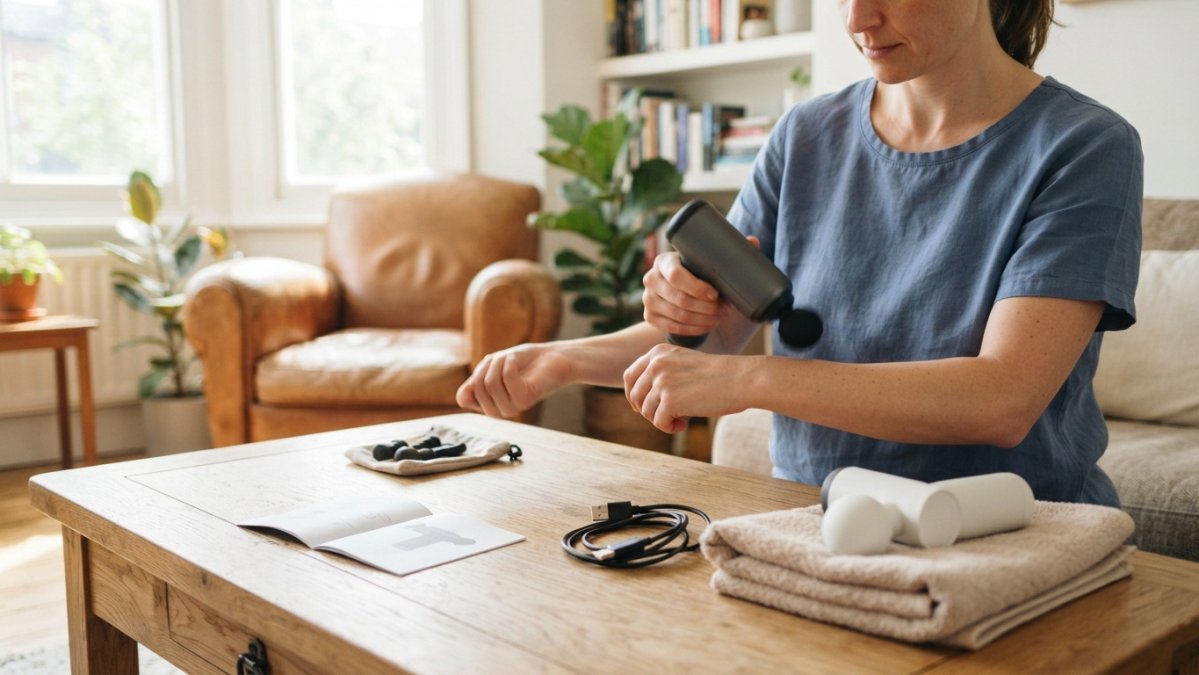
Person using a compact handheld massage gun on their forearm in a bright living room with accessories nearby.
1. Weight and grip. A lighter device is easier to hold for longer sessions. Our Deep Tissue Massage Gun weighs 1.29lbs, which is easy to grip one-handed. Look at the deep tissue option if you mainly want relief for deeper muscle tension. If you want to compare a lighter option, you can browse the Percussion Massage Gun.
Deep Tissue Massage Gun for Muscle Relief
2. Speed range and control. Speed settings matter, but so does the lowest setting. Start low, then increase gradually. A wide range (our model offers 30 levels) is useful only if the lowest levels are genuinely gentle, many cheap guns start too aggressively for neck and shoulder work.
3. Noise. Noise is often overlooked. This model runs at 40 to 50dB, which is quiet enough for use in a shared room. If you live in a flat or share a workspace, test the noise level before you commit; a loud gun discourages frequent use.
4. Battery life and charging. Battery life counts for anyone who travels or uses the device often. The 2500mAh battery runs for 6 to 8 hours and charges in 3 to 4 hours. Check whether the charger is USB-C or a proprietary plug, a proprietary charger is easy to lose and expensive to replace.
5. Attachments included. A gun with nine heads covers more areas than one with three. See the attachments section below for how to match heads to muscle groups.
6. Warranty, returns and total cost. A massage gun is a long-term purchase, so compare the warranty length and the returns window before you buy. Replacement batteries and heads are the hidden costs, a cheap gun with no spare parts can cost more over two years than a slightly dearer one with a stocked spares line.
Pro TipBefore buying, hold the device (or a similar model) for a full two minutes in the shop or at home. If your forearm tires before the timer ends, the weight is wrong for you regardless of the specs.
![A person in a bright living room holding a compact handheld massage gun against their forearm, with a charging cable and the device resting on a folded towel nearby | section:How to Choose a Massage Gun: Size, Weight, Speed and Noise]
Massage Gun Attachments Guide: Matching Heads to Muscle Groups
Attachments change how the massage feels. Flat heads cover large areas like the thighs. Ball heads suit general muscle work. Pointed or bullet heads reach tight spots near the spine or along the calf.
Match the head to the muscle group. Use a broad head for big muscles and a small head for areas close to bone. Always refer to the included guide for best results. For a non-electric option, you can browse the muscle roller stick for deep tissue massage.
Massage Gun Safety and Usage: When to Stop and When to See a Clinician
A massage gun should feel firm but never painful. Stop if you feel sharp pain, numbness, or tingling. Avoid using it directly over bones, joints, bruises, or swollen areas.
Use it for 10 to 15 minutes at a time. Start on a low speed and build up slowly. If you have a medical condition such as a blood clotting disorder, recent surgery, or a serious injury, speak to a GP or physiotherapist first. If you have a long-term condition such as arthritis, check with a clinician before adding a new routine.
Booking in Your Next Recovery Session: Choosing Your First Massager
Start small. Choose a massager for one area and use it for a few weeks before deciding whether to add another. Pick the body area you named in step one, match the device type to it, and use it for a few weeks before deciding whether to add another.
Our Heated Foot Massager with Kneading, at £38.99, weighs 3lbs and shuts off automatically after 15 minutes.
Set a simple routine. Use your chosen massager for 10 to 15 minutes, once or twice a day, and notice how your body responds. That habit matters more than any single feature on the box.
Frequently Asked Questions
How do I choose the right massager?
Start with the body area you want to treat and how you plan to use the device. A massage gun suits targeted muscle work in the legs, back and shoulders, while a shiatsu or kneading neck and shoulder massager suits longer, relaxing sessions. Check the speed range, weight and noise level, and make sure the attachment heads cover the areas you care about most. Match the device to your routine, not just to its features.
Are massage guns suitable for everyone?
Massage guns suit many adults, but they are not right for everyone. Avoid using one directly over bruises, swelling, varicose veins, open wounds, fractures or recent surgery. If you have a medical condition such as a blood clotting disorder, diabetes with nerve damage, or arthritis that causes joint pain, speak to your GP or a physiotherapist before regular use. Start on a low speed and stop if pain increases.
Which massage gun attachment should I use?
Use a large, flat head for big muscles such as the quads, glutes and back, and a smaller bullet or ball head for tighter spots and smaller muscle groups. The Deep Tissue Massage Gun for Muscle Relief from Infinite Finds includes nine specialised heads, so you can match the attachment to each area. Keep sessions to around 10 to 15 minutes, and avoid spending long periods on bony areas.