A knee brace for gym workouts is worth wearing only for a reason you can name, such as returning from a strain you have been cleared to train or patellar tracking pain during squats. Healthy knees with no symptoms do not need one, since strength work does more for long-term joint stability. Use a brace short term while you build that strength, not as a permanent habit.
Wearing a brace every session for months trains reliance on external support rather than strengthening the joint.
A compression sleeve applies compression around the knee and calf but does not mechanically stop the knee from moving.
Measure knee circumference at the kneecap centre, thigh about 15 centimetres above it, and calf at its widest point.
A brace that shifts during a set is more dangerous than no brace because it changes your movement mid-repetition.
Strengthening the quadriceps, hamstrings and glutes does more for long-term joint stability than any sleeve.
Verdict: When a Knee Brace Earns Its Place in Your Gym Bag
Most gym-goers buy a knee brace for gym workouts after something already hurts, the wrong order. A brace manages load you cannot remove; it is not a substitute for the strength work that removes it.
The knee is a hinge joint doing two jobs under a barbell: flexion and extension under load, plus a small amount of rotation. A brace cannot improve either movement, but it can be used to support the joint during activity.
Situation
Brace?
Why
Returning from a strain, cleared to train
Yes, short term
Adds joint stability while confidence rebuilds
Patellar tracking pain during squats
Yes, targeted
Pressure distribution around the kneecap
Healthy knees, no symptoms
No
Strength work does more
Watch out: wearing a brace every session for months trains reliance on external support rather than strengthening the joint.
If you are weighing a sleeve against tape, our pre-cut kinesiology knee tape is a option for sessions where you want a lighter-feeling support.
Pre-Cut Kinesiology Knee Tape.
Knee Compression Sleeve Benefits for Lifting and Recovery
Compression sleeves work differently from hinged braces: a sleeve applies compression around the knee and calf, but it does not mechanically stop the knee from moving.
A compression sleeve applies compression around the knee and calf, and the Compression Knee Pads with Leg Sleeve listing describes moderate compression. A sleeve will not replace a clinical assessment if pain persists.
For post-session recovery, our knee ice wrap with compression is shaped to the knee and comes with two reusable gel packs to alternate: freeze for a minimum of 2 hours before use, and use for up to 20 minutes per session.
Knee Ice Wrap with Compression
Our compression knee pads with leg sleeve suits high-impact training where you want coverage over both knee and calf, with a non-slip strip that holds position through repeated movement.
Compression Knee Pads with Leg Sleeve
How to Measure for a Knee Brace Before You Buy
Getting the size right matters, so check the size chart before you order. Stand up straight with weight evenly on both feet, then measure the knee circumference at the centre of the kneecap, the thigh roughly 15 centimetres above it, and the calf at its widest point, keeping the tape snug but not tight. Check both legs, use the larger measurement, and match to the size chart, not your trousers.
For sleeves, fit should feel firm without pinching or rolling at the top edge; if it bunches behind the knee during a bodyweight squat it is too loose, and if your toes tingle or the skin marks deeply, it is too tight. Achieving this precise balance is essential when modifying workouts for injuries to ensure that your joint support remains effective throughout your training sessions.
Watch out: a brace that shifts during a set is more dangerous than no brace, because it changes your movement mid-repetition without warning.
Once you have your measurements, browse the recovery tools range to compare support options side by side.
When to Wear a Knee Brace at the Gym and When to Strengthen Instead
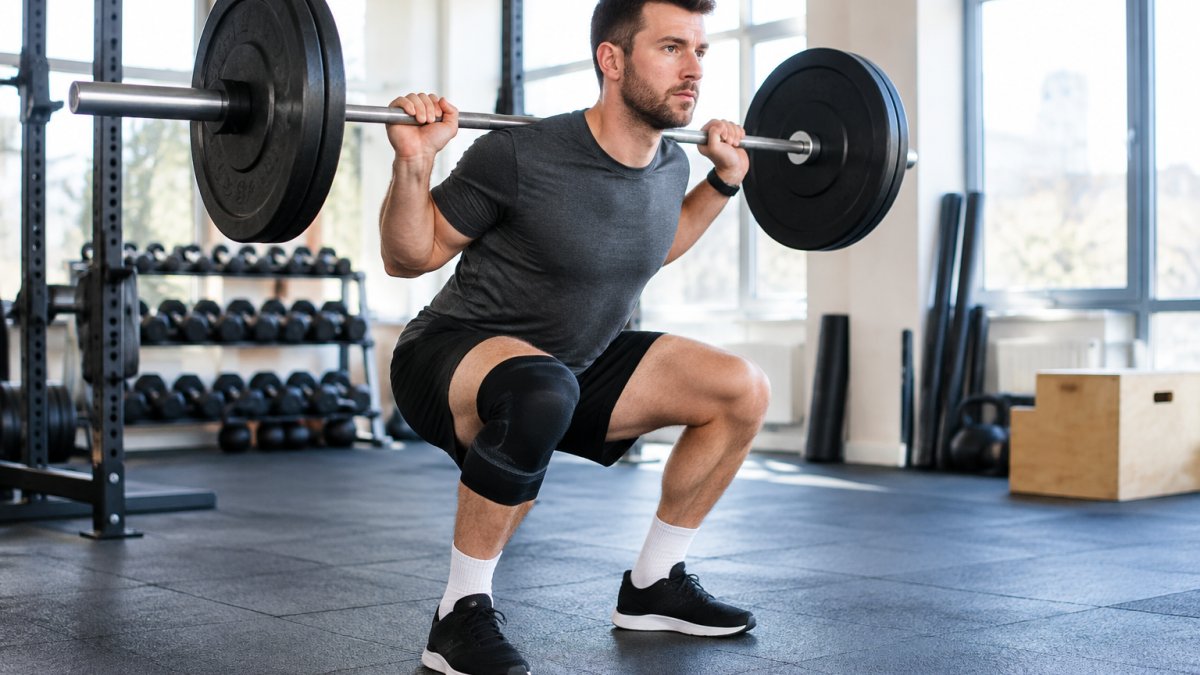
Man performing a barbell squat while wearing a black compression sleeve in a modern gym studio
A useful rule is to wear a brace for a reason you can name, rather than simply because it feels helpful.
A brace may be worn during a structured return-to-training phase, or when a clinician has recommended support for a diagnosed issue.
There is no diagnosis and no clear trigger
Pain appears only during training and settles quickly
You have been braced for more than a few months with no plan to stop
Strengthening the quadriceps, hamstrings and glutes does more for long-term joint stability than any sleeve, and range of motion work and functional patterns matter too. A brace buys time while you build that, and it should never become the permanent answer.
Knee braces are generally best used as a short-term aid rather than a permanent habit.
Frequently Asked Questions
Do I really need a knee brace for gym workouts?
Not everyone does. A knee brace may be used when a clinician has recommended support, or when you want additional support during heavy training. If your knees feel fine through full range of motion and you have no history of injury, a compression sleeve is optional. Think of support as a short-term aid alongside muscle strengthening, not a permanent substitute for it.
What is the difference between a knee sleeve and a knee brace?
A sleeve is a stretchy tube that applies compression around the knee. A brace has structural elements such as hinges or straps. For general gym training, a compression sleeve suits most people. For instability or a clinician's recommendation, a hinged or unloader brace is the more appropriate choice.
Can wearing a knee brace weaken my muscles?
Support does not replace muscle strengthening. If you wear a brace for every session and skip the work that builds joint stability, the muscles around the knee will not develop the way they should. Use a brace during heavier lifts or flare-ups, and keep a rehabilitation programme of muscle strengthening and functional movement in your week. The brace manages load; the training builds capacity.