The best massage gun for back muscles is the Deep Tissue Massage Gun for Muscle Relief at £35.99, with 30 speed levels and nine heads for upper and lower back work. For targeted upper back tension, choose the 4-head percussion gun at £44.99.
Use two to three minutes per muscle area, with a total back session of around 10 minutes.
Never apply percussion directly to the spine, neck, kidneys, ribs or inflamed areas.
A fork head straddles the spine to treat muscles on either side without pressing on bone.
For mid-back reach, place the gun head against a wall and lean into it.
The budget Percussion Massage Gun with Adjustable Speeds costs £20.99 as an entry point.
Quick Comparison: Best Massage Guns for Back Muscles
Finding the best massage gun for back muscles comes down to one awkward truth: your back is the hardest part of your body to treat yourself. You cannot see it, you cannot easily reach the mid-spine, and the muscles that cause the most trouble sit just out of comfortable range. This guide is built around that problem rather than around raw power figures.
A massage gun is a handheld percussion device that drives a padded head rapidly into muscle tissue to reduce tension and ease soreness. Percussive therapy works on muscle bellies, not on bone or spine.
Product
Price
Speeds
Heads
Best For
Deep Tissue Massage Gun for Muscle Relief
£35.99
30
9
Best overall
Percussion Massage Gun with 4 Heads
£44.99
6
4
Upper back work
Percussion Massage Gun with Adjustable Speeds
£20.99
Multiple
Check listing
Budget pick
Heated Vibration Massage Belt
£19.99
3 heat/vibration
Wearable
Lower back tension
Below, we explain how we chose these tools, what each one does well, and how to use a massage gun on your back without hurting yourself.
How We Chose and Tested These Back Massagers
Devices are best judged on back-specific criteria rather than spec-sheet figures. Reach and handle geometry matter most: a gun you cannot comfortably hold behind your shoulder is of little use, however powerful the motor.
The key points to weigh are:
Reach: can you place the head on the upper back and mid-back without straining?
Control at low speed: backs respond better to slow, steady pressure than to maximum force.
Attachment range: a round or flat head for large muscles, a fork for either side of the spine.
Weight and balance: a lighter gun held at an angle for several minutes tires the arm less.
Noise and battery: quiet operation matters if you use it in the evening.
A back massager has to work at awkward angles, and that is where many devices fall short.
1. Deep Tissue Massage Gun for Muscle Relief: Best Overall
Our top pick for back muscles is the Deep Tissue Massage Gun for Muscle Relief at £35.99. It offers 30 speed levels and nine heads, which suits the different back tissue between the upper traps and the lower back.
The 40W motor delivers up to 40lbs of force at 3300RPM and penetrates 13mm into muscle and fascia. Thirty speed levels let you start gentle and build up, and nine heads cover every area you would want to treat.
Key Specs and What They Mean for Your Back
The 2500mAh Type-C battery runs for 6 to 8 hours and charges in 3 to 4 hours, so a daily routine rarely needs a recharge. At 40 to 50dB it stays quiet enough for evening use. The 10-minute auto shut-off is designed for energy saving. At 1.29lbs it is light enough to hold behind your shoulder for a full session.
Nine heads give genuine versatility for upper and lower back
Thirty speeds allow fine control at the gentle end
Long battery life and quiet operation
Auto shut-off encourages sensible session length
Cons:
More settings than a first-time user needs
The heavier force settings are unnecessary for most back work
2. Percussion Massage Gun with 4 Heads: Best for Targeted Upper Back Work
The Percussion Massage Gun with 4 Heads at £44.99 is a percussion option with four interchangeable heads.
The brushless motor runs at 30 to 55dB and delivers 1600 to 3600RPM across six speeds. The six speed levels run from 1600 to 3600RPM. The 1.76lbs body is comfortable to hold at an angle, and the 2 to 3 hour battery covers several sessions.
3. Percussion Massage Gun with Adjustable Speeds: Best Budget Pick
If you want to try percussion massage without committing much, the Percussion Massage Gun with Adjustable Speeds at £20.99 is the sensible entry point. It offers multiple speed settings and an ergonomic handheld design, with LCD and button-operated models available.
Check the listing details before ordering. Attachment types and battery details are not specified in the current product information, so contact Infinite Finds to confirm the contents of your chosen option. Read the supplied manual for approved body areas and session length.
For lower back tension, the Heated Vibration Massage Waist Belt is an option to consider: the Heated Vibration Massage Waist Belt at £19.99 combines infrared heat with vibration across three settings, worn around the waist and lower back.
The belt combines infrared heat therapy with vibration massage, and its wearable design lets you move while it works. It is USB-powered, available in Pink and Grey, and compact at 260 × 140 × 50mm.
If you specifically want percussion on the lower back, use the Deep Tissue gun on its lowest speeds over the muscle either side of the spine. View the heated waist belt for a gentler alternative.
Choosing the right head and speed suits the muscle being treated. Match the head to the muscle and the setting to the tissue.
Head-to-area matching
Round head: the default for large back muscles, including the lats, the glutes, and the muscles beside the shoulder blade. Use on a low to medium speed for broad, even pressure.
Flat head: broad, even pressure across the upper back and the meat of the lower back. It covers more surface than the round head and is useful when you want to work a wider area without chasing knots.
Fork head: straddles the spine to treat the muscles on either side without pressing on bone. This is the most back-specific head and the one most often missing from budget kits. Use it on the upper back beside the spine, never on the neck.
Bullet head: precise work on small knots around the shoulder blade, used lightly and briefly. It concentrates force, so keep the speed low and do not hold it still.
Air-cushion or soft head: gentler for tender areas and bony prominences. Useful for the lower back where the tissue is thinner.
Intensity matching by tissue type
The back is not one tissue. The upper traps and lats are thick and tolerate moderate percussion; the lower back and the area over the ribs are thinner and respond better to low speeds and lighter pressure. A practical rule is to start one or two settings below what feels 'effective' and build only if the muscle relaxes rather than tenses.
If your device has a timer, use it; if not, set one on your phone.
The attachment most kits get wrong
A common mistake is reaching for the firmest, most focused head first. Start with round or flat, keep the speed low, and only move to a more focused head once you know how the muscle responds.
Watch out: using a bullet head at high speed over a bony area such as the shoulder blade or the lower ribs can cause bruising. Keep focused heads for muscle bellies only.
How to Use a Massage Gun on Your Back Safely
Safety on the back is simple to state: work the muscle, never the spine, the kidneys or the neck. But the back is also the hardest area to treat yourself, so safe use depends as much on how you hold the device as on where you point it. This section covers placement by muscle area, ergonomic workarounds for self-use, and the limits of what percussion can reasonably do. Because the neck is off-limits for back percussion, treat it as a separate area with its own approach rather than extending a back routine to neck massagers.
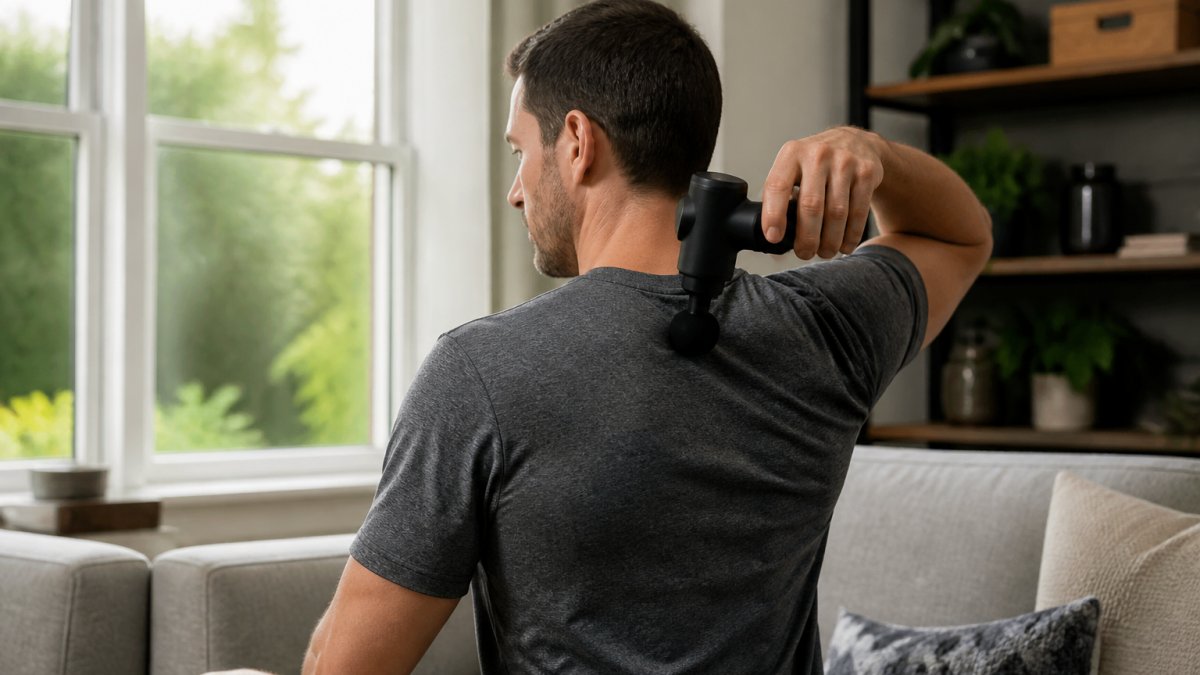
Person sitting on a sofa using a percussion massage device on their upper back in a bright living room
Safe placement by back area
Upper back and shoulder blades. The muscles beside the shoulder blade (rhomboids and mid-traps) are the safest and most rewarding target.
Lower back. Work only the muscle columns either side of the spine (erector spinae), staying well clear of the kidney area, which sits roughly between the bottom of the ribcage and the top of the pelvis.
Lats and sides. The large latissimus dorsi muscles respond well to a round head on a moderate speed. Reach them by raising the arm on the side you are treating, which opens the muscle and makes the angle easier.
Glutes. Often the source of referred lower back tightness, the glutes are large and forgiving. A round or flat head on a medium speed works well, but keep away from the tailbone and the bony point of the hip.
Areas to avoid entirely. Never apply percussion directly to the spine, the neck (especially the front and sides), the kidneys, the ribs, or any area that is bruised, swollen or inflamed.
Ergonomic workarounds for self-use
The mid-back is the hardest spot to reach. Three practical workarounds help:
Over-the-shoulder reach: for the upper back, hold the gun over the opposite shoulder and angle the head down. A lighter device (under about 1.5kg) makes this sustainable for a full session.
Wall-assisted placement: for the mid-back, place the gun head against the wall at the right height and lean into it, letting the wall take the weight. This works best with a device that has a flat or round head and a stable body.
Seated rotation: sit on a firm chair and rotate your torso slightly toward the side you are treating. This opens the reach and reduces strain on the shoulder.
A common pattern is to overreach and twist the wrist or shoulder while trying to hit the mid-spine. If you find yourself contorting, stop and use a wall or a partner instead.
What percussion can and cannot do
Percussion massage is generally used as a temporary muscle-relief tool for everyday tightness and post-exercise soreness, and is not a treatment for persistent back pain, nerve pain (such as sciatica), or any diagnosed condition. If pain is sharp, radiating, or lasts beyond a few days, speak to a healthcare professional before using a massage gun on the area.
Watch out: pressing hard on a sore spot and holding still can leave you sorer the next day. Keep the head moving, keep the pressure light, and stop if anything sharpens rather than eases.
How Long Should You Use a Massage Gun on Your Back?
Two to three minutes per muscle area is enough for most people, with a total back session of around 10 minutes. Longer is not better.
The Deep Tissue pick includes a 10-minute auto shut-off. If your device has no timer, set one on your phone.
Stop sooner if the area feels warm, tender or numb. Soreness that lasts beyond a day suggests you used too much force or stayed on one spot too long.
Choosing Your Back Recovery Tool at Infinite Finds
The right choice depends on where your tension sits. Upper back and shoulder tension points to the 4-head percussion gun. Broad, general tightness suits the Deep Tissue gun and its nine heads. Lower back aches favour the heated waist belt.
If you would rather work through the decision properly, our guide on how to choose the right massager walks through seven steps covering reach, intensity, attachments and routine. Free UK delivery is available, and you can contact Infinite Finds with questions about attachments or model contents before you buy.
Frequently Asked Questions
Can you use a massage gun on your back?
A massage gun can be used on the large muscle groups of your back, such as the upper back, lats and lower back muscles either side of the spine. Keep the head on muscle tissue and avoid pressing directly onto the spine, shoulder blades or kidneys. Use a low speed to start and move the device slowly rather than holding it in one spot. If you have an injury, a medical condition or ongoing pain, speak to a healthcare professional before use.
Which massage gun attachment is best for back muscles?
A round or ball head suits the large, flat areas of the back because it spreads pressure across a wider surface. A flat head works well for general use along the upper back, while a fork head can straddle either side of the spine without pressing on it. Avoid bullet heads on the back, as they concentrate force into a small point. The Deep Tissue Massage Gun includes nine heads, giving you options for both broad and targeted work.
How long should you use a massage gun on your back?
Most sessions work best at 10 to 15 minutes in total, moving across the muscle groups rather than staying in one place. Hold on a tight spot for around 20 to 30 seconds, then move on. The Deep Tissue Massage Gun has a 10-minute auto shut-off. Start on a low speed and build up gradually, and stop if you feel sharp pain rather than a dull ache.
Can a massage gun help with back muscle tightness?
Percussion massage is generally used to address muscle tension and soreness on a temporary basis. It is not a treatment for underlying back pain or spinal conditions. Think of it as a recovery tool for muscular tightness after desk work, training or long periods on your feet. If tightness persists or comes with numbness, weakness or pain down your legs, seek advice from a healthcare professional.
What should you look for when buying a massage gun for your back?
Focus on reach and control rather than raw power. A lightweight device with an ergonomic handle lets you reach your upper back without straining your shoulder. Adjustable speed settings help you work gently near the spine, and a range of attachments covers both broad and targeted areas. Battery life and noise level matter if you plan to use it daily. The Deep Tissue Massage Gun offers 30 speeds, nine heads and 6 to 8 hours of battery per charge at £35.99.
Your back is the one area where a rushed purchase shows up fast, because a device you cannot reach comfortably ends up in a cupboard. We would rather you picked the tool that fits your body and your routine than the one with the biggest motor. Start with the Deep Tissue Massage Gun for its nine heads and thirty speeds, or the heated waist belt if your tension sits low and constant. Get started with Infinite Finds and build a short, repeatable recovery routine that actually fits your day.